How to Evict a Tenant in Thailand (2026 Guide)

How to Evict a Tenant in Thailand (2026 Guide)
Evicting a tenant lawfully in Thailand requires landlords to follow a strict legal sequence. Since the Notification of the Contract Committee B.E. 2568 took effect on 4 September 2025, rules have tightened considerably for landlords classified as "business operators" under the Office of the Consumer Protection Board (OCPB). Self-help measures like changing locks or cutting utilities are strictly illegal.
Quick Pre-Action Checklist
Before taking legal action, ensure you have completed the following:
- Review the Lease: Confirm tenancy type (fixed-term or periodic) and notice clauses.
- Classify OCPB Status: Determine if you are a "business operator" (renting out 3 or more residential units).
- Identify Legal Grounds: Document non-payment, breach of contract, or expiry of term.
- Gather Evidence: Compile rent ledgers, damage photos, and correspondence.
- Attempt Amicable Resolution: Send a written settlement offer with a clear deadline first.
- Serve Written Notice: Use registered post or personal service with witnesses; preserve all tracking slips.
Step 1: Verify Regulatory Status (OCPB vs. CCC)
Residential leasing laws depend on the scale of the landlord's operation:
- Business Operators (3+ Units): Any landlord letting out 3 or more residential units (regardless of location or digital platform status) is bound by OCPB rules. They must use the mandated Thai-language Standard Form Contract. Deviating from these terms makes the clause void and exposes the landlord to up to 1 year imprisonment and/or a fine of up to 100,000 Baht under the Consumer Protection Act.
- Private Landlords (1-2 Units): Subject primarily to the general Civil and Commercial Code (CCC).
Note: Under Section 538 of the CCC, any lease exceeding 3 years must be written and registered at the local Land Office, or it will only be enforceable for 3 years.
Step 2: Statutory Eviction Notice Timelines
For OCPB-controlled tenancies, custom lease clauses allowing shorter notices are void. Landlords must follow these timelines:
- 30-Day Cure Notice (หนังสือแจ้งให้ปฏิบัติตามสัญญาและชำระค่าเช่าค้างชำระ): For standard breaches (rent arrears, property damage, unauthorized subletting), tenants must be given at least 30 days from receipt to remedy the breach.
- 7-Day Urgent Notice (หนังสือแจ้งเตือนกรณีสร้างความเดือดร้อนรำคาญ): If the tenant causes a severe nuisance that disrupts neighbors, the cure period can be reduced to at least 7 days.
- Immediate Rescission (การบอกเลิกสัญญาเช่าทันที): Allowed without prior notice only if the tenant engages in serious criminal activities on the premises (e.g., drug manufacturing or human trafficking). Landlords must still involve law enforcement and cannot lock the tenant out personally.
Step 3: Deposit Caps & Strict Refund Timelines
Landlords must adhere to mandatory financial caps and strict statutory return windows:
Payment & Deposit Caps
- Short-Term Leases (≤ 3 years / monthly): Combined security deposit and advance rent cannot exceed 3 months' rent. Advance rent is capped at 1 month, meaning the security deposit can be a maximum of 2 months' rent.
- Long-Term Leases (annual payments): Combined deposit and advance rent capped at 1 year's rent.
Statutory Refund Timeline
Upon lease termination, the deposit must be returned under these strict timelines:
- Immediate Refund: If no property inspection is required.
- Within 7 Business Days: If an inspection shows no damage beyond ordinary wear and tear.
- Within 14 Days: If verifiable damage is found. Landlords can deduct repair costs but must provide an itemized statement, contractor invoices, and time-stamped comparison photos.
Step 4: The Court Eviction Process
If the notice period expires and the tenant refuses to vacate or cure the breach, the landlord must file a lawsuit.
The 3 Stages of Court Eviction
Timeline and Costs
- Uncontested Cases: 3 to 4 months from filing.
- Contested Cases: 6 to 12 months (longer if appealed).
- Costs: Landlords must budget for court filing fees, lawyer fees, process-service costs, and enforcement fees.
Landlord Dos and Don'ts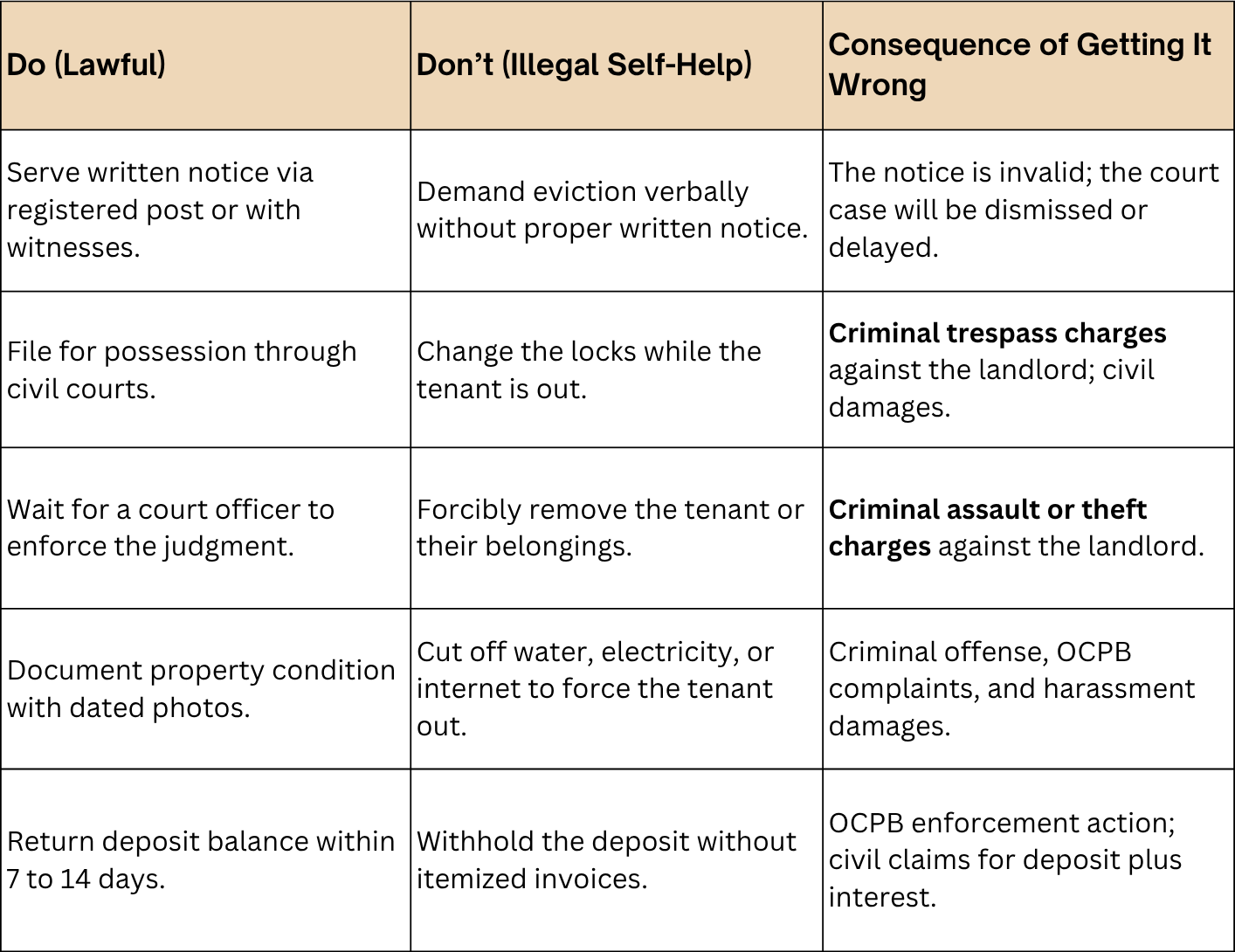
Statutory Document Templates
All official notices must be drafted in Thai (with English translations provided for foreign national tenants):
- Template 1: Notice to Pay and Remedy Breach (หนังสือแจ้งให้ปฏิบัติตามสัญญาและชำระค่าเช่าค้างชำระ) – Must explicitly state a remedy period of at least 30 days from receipt.
- Template 2: Notice to Comply or Vacate for Nuisance (หนังสือแจ้งให้ปฏิบัติตามสัญญาหรือออกจากสถานที่เช่าเนื่องจากก่อเหตุเดือดร้อนรำคาญ) – Must state a remedy period of at least 7 days from receipt.
- Template 3: Notice of Termination at End of Fixed Term (หนังสือแจ้งสิ้นสุดสัญญาเช่า) – States the lease expiry date, intent not to renew, and move-out/deposit inspection instructions.