Financial Calculations, Taxation, and Risk Mitigation

The financial mechanics of renewing a 30-year lease in Thailand involve statutory administrative
registration fees, revenue taxes, and local withholding requirements. Understanding these cost
components enables accurate financial modeling and prevents operational delays during Land Office
submission.
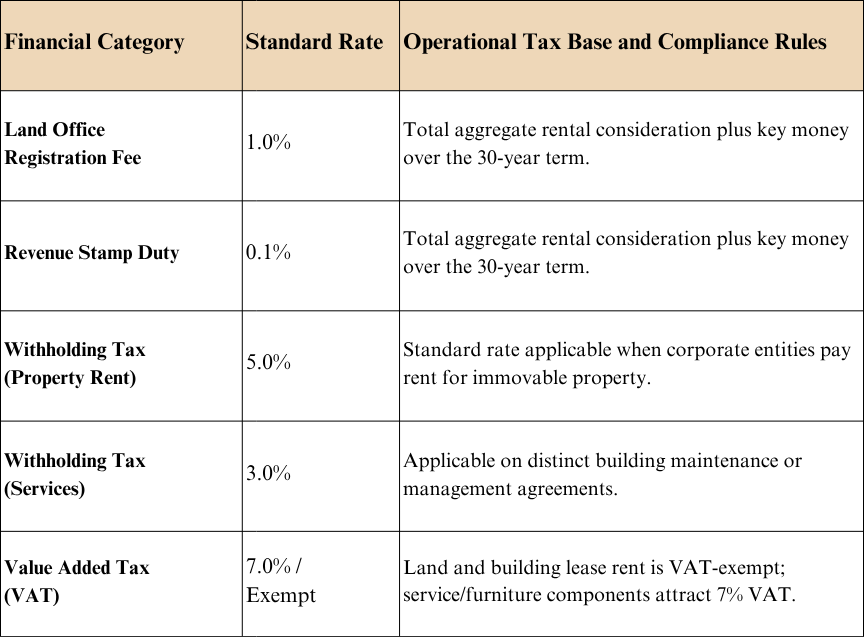
The Land Office levies a statutory lease registration fee equal to 1% of the total cumulative rent over the
full 30-year term. In addition, stamp duty is assessed at a rate of 0.1% (THB 1 per THB 1,000 or fraction
thereof) of the total contract value. The financial base used for these calculations encompasses all
mandatory payments under the contract, including base rent, key money, upfront premiums, and tenant
contributions toward landlord construction or land surveys.
Mathematically, if Rtotal represents the total cumulative basic rent across the entire 30-year duration and K represents upfront key money or development contributions, the aggregate consideration base (T) is defined as:
T = Rtotal + K
The statutory registration fee (Freg) and stamp duty (Sduty) payable at the Land Office are determined by:
Freg = 0.01×T
Sduty = 0.001×T
Under Section 539 of the CCC, the costs of contract registration are shared equally between the lessor and lessee by default, though parties routinely alter this allocation by explicit contractual agreement. Land Office officials review declared rental values against official government appraised property values, if the declared rent is unnaturally nominal, authorities reserve the right to assess fees based on government appraisals.
When structuring corporate tenancies, entities must account for withholding tax obligations. Pure immovable property rentals attract a 5% withholding tax, whereas distinct service components such as building maintenance or equipment rentals, attract a 3% withholding tax and incur 7% VAT. Separating real property rental from service components in distinct agreements optimizes tax treatment, provided the separation reflects genuine commercial arrangements.
Mitigating operational and legal risks during lease renewal requires structured oversight. Lessees frequently expose themselves to severe liabilities by under-declaring rental values to minimize registration fees, which can trigger revenue audits and invalidate enforceability. Risk is further compounded when lessees rely on informal oral promises, overlook unrecorded property mortgages, or fail to complete formal Land Office registration before the original term expires. By maintaining detailed title due diligence, engaging in early renewal negotiations, transparently accounting for total consideration, and ensuring prompt registration, stakeholders effectively preserve their legal rights and real estate equity under Thai law.