Condo vs House in Thailand 2026: Tax, Ownership Risks, and When to Hire a Property Lawyer

For expatriates, foreign investors, and long-term residents looking to acquire real estate in
Thailand, the threshold question remains critical: Should you purchase a condominium or a
house?
In 2026, this decision carries distinct financial and legal weight. The full implementation of updated
municipal property valuations under the Land and Building Tax Act B.E. 2562 (2019) has
fundamentally altered holding costs, widening the annual tax gap between land-heavy houses and
structural condominium units.
This comprehensive, lawyer-led guide provides an analytical breakdown of your options—covering
statutory frameworks, tax liabilities, compliance risks, and closing mechanics—so you can make
an informed property decision based on verified data.
Section 1: Option A – Buying a Condominium in Thailand
Legal Foundation and Freehold Mechanics
The statutory mechanism for direct, foreign-name property ownership is governed by the
Condominium Act B.E. 2522 (1979), as amended. This remains the only Thai law that permits a
foreign national to register a direct freehold title (Chanote) for residential property in their own
name. To register the transfer at the Department of Lands, two structural requirements must be
met simultaneously:
- The 49% Foreign Quota Rule: The aggregate floor area owned by foreign nationals within
the registered condominium building must not exceed 49% of the total saleable area. The
remaining 51% must remain under Thai ownership.
- The Foreign Exchange Transaction (FET) Requirement: The foreign buyer must prove that
funds equivalent to or exceeding the full purchase price were remitted into Thailand in
foreign currency through a licensed Thai commercial bank. This must be validated via an
official FET Form (formerly known as a Tor Tor 3).
Critical Due Diligence Step: The condominium’s juristic person must issue a formal certificate
confirming quota availability before the Land Office will process the transfer. Prospective buyers
should audit the current foreign quota ratio through an independent legal check before executing a
reservation agreement or parting with a non-refundable deposit.
Financial Commitments and Ongoing Costs
While purchase prices vary significantly—ranging from under THB 2 million for suburban studios to
well above THB 20 million for prime luxury units in Bangkok or Phuket—condo owners face specific
ongoing financial liabilities:
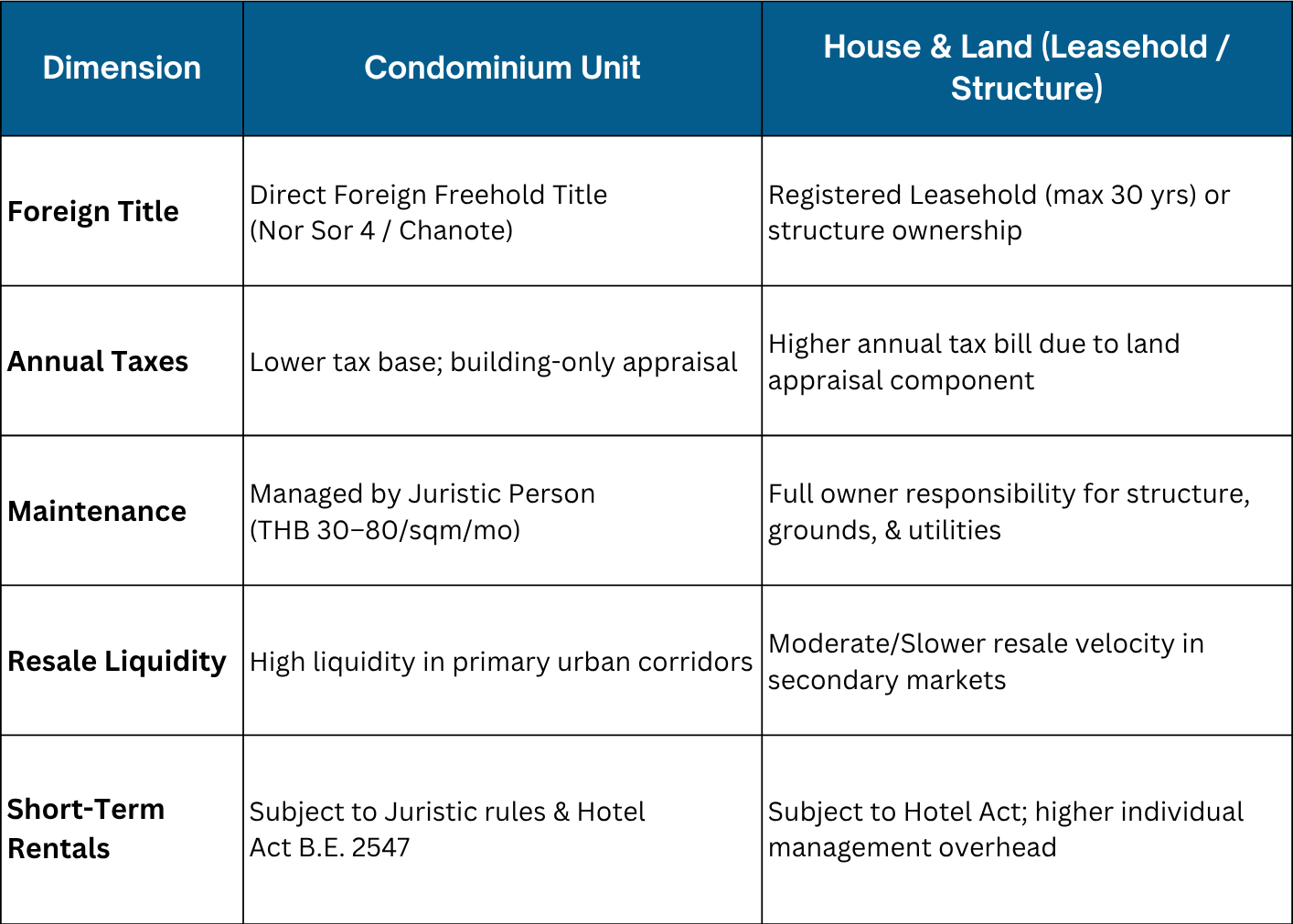
- Common Area Management (CAM) Fees: Paid monthly or annually to the juristic person to
cover security, maintenance, building insurance, and shared utilities. These typically range
between THB 30 to THB 80 per square metre, per month.
- Sinking Fund Contribution: A one-time lump-sum payment collected upon transfer to fund major future structural repairs, typically ranging from THB 500 to THB 1,000 per square metre.
- Individual Contents Insurance: The building’s master policy only covers common structures; private unit interiors and personal assets require independent coverage.
Strategic Pros and Cons of Condo Ownership
- Pro: Direct Freehold Title: The asset is registered directly in your name. There are no
corporate structures, nominee risks, or lease-expiry timelines to manage.
- Pro: Low Maintenance Overhead: The juristic person handles structural repairs, security,
landscaping, and community management, making it an ideal "lock-up-and-leave" asset.
- Pro: High Market Liquidity: Condominiums in prime urban and resort centers enjoy a more
active secondary market, resulting in faster liquidation timelines than houses.
- Con: Quota Availability Limits: If a desirable building's 49% foreign quota is exhausted,
you cannot register a freehold title, regardless of the purchase price or contract terms.
- Con: Juristic Governance: Owners are bound by collective juristic regulations.
Committees can legally ban pets, restrict internal renovations, or enforce strict bans on
short-term rentals.
- Con: Structural Depreciation: You do not own a distinct parcel of land. Capital
appreciation is strictly dependent on building maintenance, brand equity, and localized
structural demand.
Section 2: Option B – Buying a House and Land
The Statutory Bar and Alternative Ownership Routes
Section 86 of the Thailand Land Code expressly prohibits foreign nationals from owning land
outright, with narrow exceptions reserved for massive Board of Investment (BOI) promotions.
Furthermore, corporate entities operating under the U.S.-Thailand Treaty of Amity are strictly
barred from land ownership and real estate development.
To acquire a house and land, foreign buyers must utilize one of three primary legal frameworks,
each carrying distinct regulatory risks in 2026:
1. The Registered Leasehold Structure (30-Year Limit)
The land is leased to the foreigner, while the physical house structure can be owned directly. The lease must be registered on the title deed at the local Land Office under Section 540 of the Civil and Commercial Code (CCC).
2026 Legal Update: Contractual mechanisms designed to bypass the 30-year statutory cap—such
as pre-paid "30+30+30" automatic renewal clauses—have been declared void ab initio (legally
invalid from the outset) under Supreme Court Judgment No. 4655/2566. A lease terminates
automatically upon the expiration of the initial 30-year registered term. Personal renewal promises
are legally unenforceable and do not bind successors, heirs, or third-party buyers of the land.
2. The Thai-Majority Corporate Structure (Nominee Risk)
A Thai limited company is incorporated to hold the land title, with the foreign buyer typically
positioned as a minority shareholder (holding a maximum of 49% of shares) paired with preferential
voting rights and a directorship.
- Criminal Liability: Under Sections 111 and 113 of the Land Code, as well as Section 36 of
the Foreign Business Act (FBA), using Thai proxy shareholders (nominees) to hold land for
a foreigner carries severe penalties. Foreigners and their Thai proxies face up to 3 years of
imprisonment and fines ranging from THB 100,000 to THB 1,000,000, alongside a
mandatory court-ordered disposal of the land under Section 96.
- Audit Enforcement: In line with DBD Order No. 1/2569, the Department of Business
Development and the Department of Lands strictly audit corporate setups, checking bank
records to ensure Thai shareholders genuinely funded their equity stakes rather than acting
as empty proxies.
3. Spouse Ownership post-Marriage Equality Act
A foreign national married to a Thai citizen can purchase land, provided the property is registered
solely in the Thai spouse’s name.
- Following the enactment of the Marriage Equality Act B.E. 2567 (which established
complete gender-neutrality in marital property rights), both legally married spouses must
jointly sign a formal declaration at the Land Office.
- This declaration legally confirms that the purchase funds are entirely the separate
property (Sin Suan Tua) of the Thai spouse, thereby waiving any marital property (Sin
Somros) claims by the foreign spouse.
Financial Realities and Capital Allocation
A house purchase shares the same fundamental transfer tax categories as a condo, but introduces
independent maintenance burdens. The owner is solely responsible for structural integrity, private
utility infrastructure, perimeter security, pest control, and localized estate management fees if
situated inside a gated housing development (Moo Baan).
Strategic Pros and Cons of House Ownership
- Pro: Spatial Freedom and Privacy: Maximum square footage, private gardens, and
absolute autonomy over architectural adjustments and renovations without needing juristic
approval.
- Pro: Land Value Appreciation: In suburban growth corridors with major infrastructure
expansions (such as new mass transit lines or motorways), land value growth often
outpaces condominium appreciation.
- Pro: Absence of Communal Bans: Complete freedom regarding pet ownership and
general property utility, free from the constraints of building-wide committee votes.
- Con: Institutional Structural Risk: No direct, risk-free freehold title is available to foreign
nationals. Every available route relies on a fixed-term lease or an audited corporate setup.
- Con: Heightened Tax Exposure: Houses feature large land plots. Under the current
property tax regime, these assets generate significantly higher annual tax valuations.
- Con: Illiquidity: Houses feature a much slower transaction cycle, requiring extended
marketing windows to locate eligible buyers on the secondary market.
Section 3: Deep Dive into the 2026 Property Tax Landscape
The Land and Building Tax Act B.E. 2562 Realities
The annual property tax is assessed by local municipal authorities against the official Treasury
Department appraised values—not the market contract price. As municipalities have finalized
their comprehensive revaluation sweeps, land-heavy holdings face highly accurate and elevated
tax assessments.
A critical point of differentiation lies in how the Primary Residence Tax Base Exemption is applied
(applicable only if the owner's name is registered in the official house registration book (Tabien
Baan) on January 1st of the tax year):
- Combined Land and Building Ownership (Freehold Houses): Individual owners benefit
from a primary residence tax exemption on the first THB 50 million of the official appraised
value.
- Building/Structure Only Ownership (Condos & Houses on Leased Land): Because the
individual owns only the structure and not the underlying land, the primary residence
exemption is strictly capped at THB 10 million.
Tax Calculation Example: For a primary condominium unit or a leasehold villa with an official
municipal appraisal of THB 15 million, the THB 5 million portion exceeding the initial THB 10
million threshold is immediately subjected to the baseline residential tax tier of 0.02% (equal to
THB 1,000 annually).
- Second Homes and Investment Portfolios: For any property utilized as an investment
asset, secondary holiday home, or rental unit, zero exemptions apply. The progressive
residential tax rate schedule applies immediately from the first Baht of the property's
appraised value.
Financial Simulation (THB 3 Million Appraised Property)
The following simulation demonstrates the transactional and holding cost distributions for an asset
valued at THB 3 million. Actual distributions remain subject to private contractual negotiation.
Section 4: When to Engage a Property Lawyer
Many buyers mistakenly treat legal representation as an optional administrative step. In Thailand’s
real estate market, independent legal due diligence is a vital risk-mitigation step that should be
executed before signing any reservation contract or paying a non-refundable deposit.
You should instruct a property lawyer in the following scenarios:
- Navigating Foreign Condo Quotas: A lawyer will run an independent audit of the juristic
ledger to verify that the building's foreign quota has not been exceeded, ensuring your funds
are safely convertible into a freehold title. They also ensure your bank transfers are
structured correctly to yield the mandatory FET Form.
- Drafting Safe Leasehold Agreements: In light of the Supreme Court ruling (No.
4655/2566) against automatic extensions, standard template leases are no longer safe. A
lawyer is required to draft custom contractual mechanisms, succession structures, and
purchase options to maximize protection within the 30-year limit.
- Vetting Non-Chanote Title Deeds: Houses located in rural or peri-urban expansion zones
may be held under lesser titles like Nor Sor 3 or Nor Sor 3 Gor. These lack precise GPS
boundary mapping. A lawyer must verify these titles, check for historical border disputes,
and confirm the absence of hidden judicial liens or mortgages.
- Managing High-Value Closings (Above THB 10 Million): Large transactions require
custom escrow agreements, precise contractual allocations of Land Office tax splits
(Transfer Fee, SBT, and Withholding Tax), and structured transaction management.
- Ensuring Rental Compliance: If you plan to generate rental returns, a lawyer will audit the
development against the Hotel Act (essential for short-term or daily rentals), verify juristic
rules, and structure your local tax compliance strategy.